Spunbond
Spunbond is a nonwoven polypropylene material made by the spunbonding process. Its essence lies in the fact that the melted polymer is released through the dies in the form of thin continuous threads, which are then pulled in the air flow and, lying on a moving conveyor, they form a textile fabric. The threads on the formed fabric are subsequently bonded. If necessary, technologies are used to make the material softer, more fire-resistant, and heat-resistant, depending on the specifics of use in various industries.
main areas of application of spunbond

Medicine

Furniture production

Agriculture

Industry

Construction

Hygiene products


Multifunctional polypropylene material: lightweight, moisture-resistant and hypoallergenic - ideal for packaging, sewing bags, furniture, agriculture and medicine
Spunbond is a durable, breathable and environmentally friendly non-woven material
Spunbond is a modern non-woven polypropylene obtained by thermal bonding of fibers without the use of chemical binders. It is characterized by high strength and lightness, which makes it in demand in a variety of areas.
What is spunbond: more about the material
During production, synthetic fibers (polypropylene) are mechanically woven and then fixed under high temperature. The result is a lightweight, durable, wear-resistant material that is ideal for a wide range of applications.
If you answer the question of what spunbond is, more simply, it is a safe, universal material that is actively displacing plastic, films, and even fabrics from the market. Companies are looking to buy spunbond both for production needs and for manufacturing products under their own brand.
Properties and characteristics of spunbond
This material is valued in various industries precisely for its unique balance of strength, flexibility, and stability. Below we will analyze the key properties of spunbond that make it an indispensable material.
Density and weight of the material
One of the first parameters that people pay attention to when choosing is density. It is available in the range of 8-150 g/m²:
- 8–50 g/m² — for light covering materials and agrofibre;
- 50-120 g/m² — for packaging, textiles, bags;
- from 100 g/m² — for durable promotional products and furniture.
When buying, it is important to choose the density correctly. After all, this allows you to precisely adapt the material to the tasks.
Durability, breathability and waterproofness
Despite its lightness, the material is highly wear-resistant and tear-resistant. Due to its structure, it is durable and suitable for multiple use. Another advantage is that this fabric analogue provides air permeability, which is important for SMS and SMMS fabrics.
Resistance to UV radiation and temperatures
When used outdoors, for example as agrofibre for beds, the material can be equipped with anti-UV treatment. This protects the fibres from destruction in the sun.
Hypoallergenic, environmentally friendly and safe
The material does not contain toxic impurities, it is safe in contact with skin and food. Due to the absence of glues, formaldehydes, and other additives, it:
- hypoallergenic - suitable even for medical products;
- is produced without harming the environment - there are no emissions;
- makes possible the recycling of secondary raw materials, reuse.
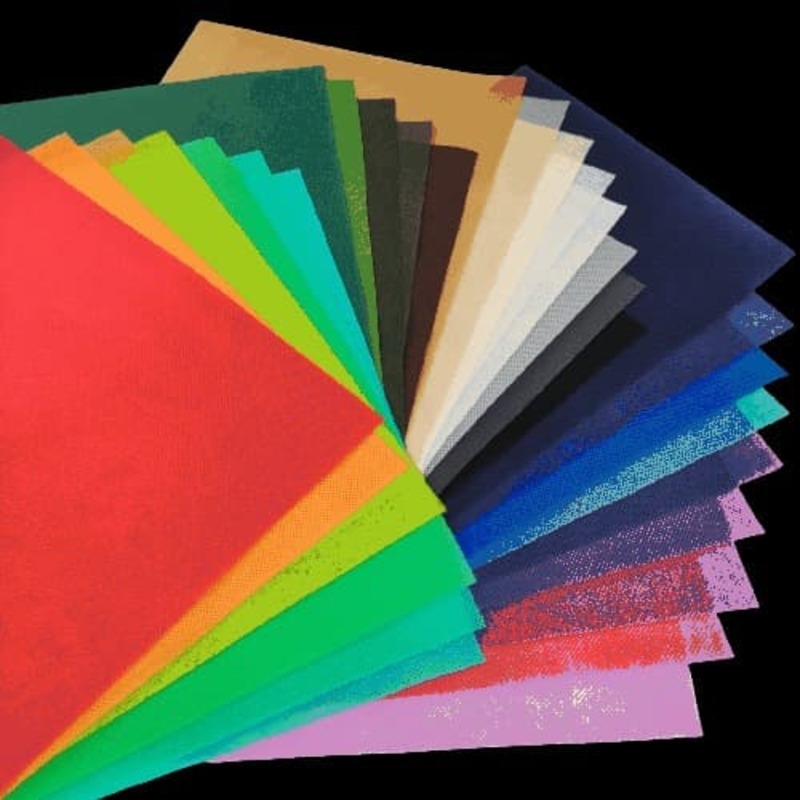
Also in demand is a colored analogue, which is dyed with safe pigments that are resistant to fading.
Where is spunbond used?
Universality is one of the main reasons why people from a wide range of industries want to buy spunbond. The material is successfully used where lightness, strength, hygiene, and cost-effectiveness are important. Below are the main areas in which the properties of spunbond are revealed 100%.
In agriculture (agrofibre)
One of the most popular options for using the material is agrofibre for beds. This is a special covering material that:
- protects plants from frost and overheating;
- permeable to air and moisture;
- reduces evaporation, maintains microclimate.
Agrofabric made of non-woven polypropylene significantly improves crop yields and reduces the need for chemicals. Rolls of spunbond with UV protection are especially in demand.
In medicine (gowns, masks)
Spunbond is a standard in medicine. It is used for:
- sewing disposable gowns, masks, shoe covers;
- sterile packaging;
- barrier protection.
In medicine, combined materials are often used - SMS and SMMS fabric, in which the material is combined with other layers for enhanced filtration, as well as additional strength.
In packaging, construction, furniture and light industry
This material is also actively used in production and logistics. Firstly, it is valued as a high-quality base for packaging furniture or equipment. It is also used to make covers, bags, cases, as well as filters, gaskets, and pads. In addition, it is used in the clothing industry.
Thus, the decision to buy spunbond wholesale is strategic for business: economical, stable, safe. It has already become indispensable in many industries, and the demand for it continues to grow.
Spunbond - where to buy and what is the price?
Cost and delivery options are important factors when choosing a material. We adhere to the principle of transparent pricing: the price for spunbond is formed on the basis of circulation, density, format, color and payment method. The price is only a guideline, you will receive the final offer after consultation with the manager.
Retail and wholesale prices for spunbond
You can buy spunbond at retail at the basic price, but we are primarily focused on business. For wholesale customers we offer:
- individual calculations;
- flexible payment system;
- deliveries under contract.
Want to buy spunbond wholesale? Contact us directly - we have our own production of non-woven material, quality control, stable supplies.
Purchase options - rolls, cuts, footage
You can buy a roll of spunbond, as well as order the material in the required length or in the form of ready-made cuts. We work with:
- classic white and colored material;
- density 8-150 g/m²;
- using special additives: UV-stabilizing, hydrophobic, antimicrobial;
- options with lamination (laminated spunbond);
- breathable and moisture-resistant membranes.
We tailor each order to the client's needs - from standard covering solutions to branded reusable products.
Where to buy cheap (Ukrainian manufacturers and suppliers)
If your goal is to buy spunbond cheaply, work directly with the manufacturer. Rendpacoeco is a Ukrainian company with experience and an established production cycle. This means:
- without intermediaries;
- quality control;
- adaptation to the required deadlines;
- delivery guarantee.
Cooperation with us is convenient, transparent, and profitable. From consultation to delivery, we accompany the client at every stage.
Harm and safety of use
Despite the fact that spunbond is made from polypropylene, it is not toxic or dangerous. It is non-woven polypropylene that has undergone mechanical and thermal processing without the use of chemicals.
No harmful substances are released during production, and the finished material is completely safe for people or the environment. Questions about the harm of spunbond are often asked - it is important to understand that:
- high-quality heat-bonded material does not emit odor;
- does not cause allergies;
- does not accumulate static electricity;
- it is even used in medicine.
Spunbond in medicine is direct evidence of safety. If the material were toxic or harmful, its use in such a sensitive area would be prohibited.
However, there are cheap analogues on the market that are produced without certification. In such cases, the following are possible:
- unpleasant smell;
- uneven structure;
- use of questionable raw materials;
- deteriorated properties (tears, fades, dusts).
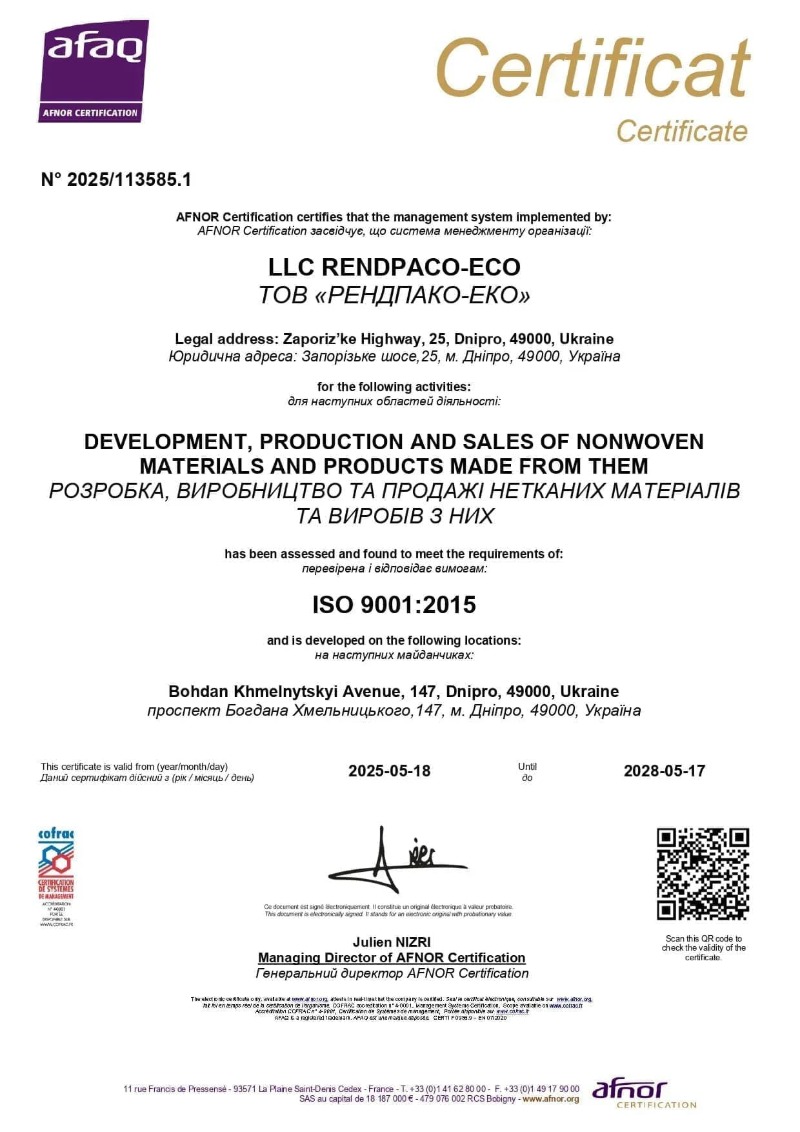
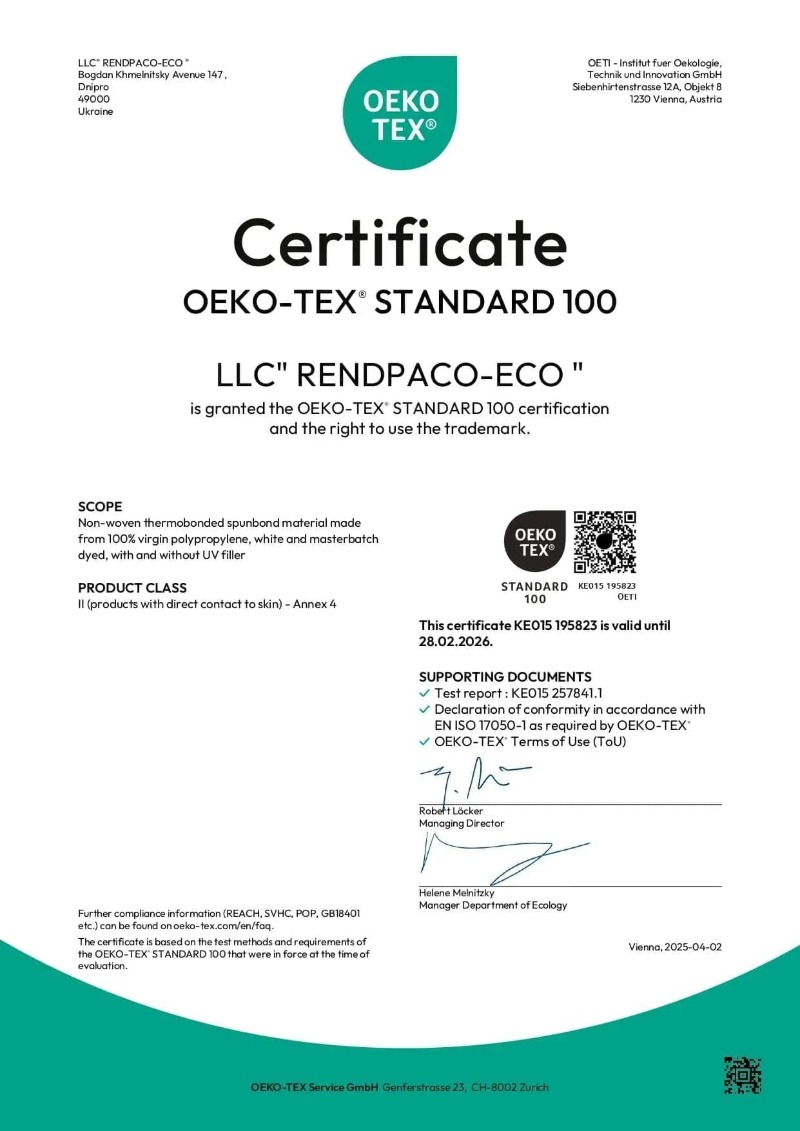
Therefore, we recommend working only with trusted manufacturers who have quality control and international certificates of conformity. Rendpacoeco uses only environmentally friendly raw materials and modern equipment that excludes any harmful impurities.
Does spunbond decompose and how to dispose of it?
What is spunbond in the context of ecology is one of the most frequent requests. The material is durable, but this does not mean that it is harmful. On the contrary, proper use, as well as disposal, help reduce the harm to the environment caused by single-use plastic.
Conditions for recycling and reuse
Recycling of spunbond is possible - it is produced from thermoplastic polypropylene, which is suitable for this. The most important conditions: purity of the material (no dirt or paint); sorting by density; appropriate infrastructure of the processing plant.
Is it recyclable?
You can buy spunbond taking into account its secondary use. After all, the material does not lose its characteristics after recycling. It can be reused in technical textiles. In addition, it is excellent for cyclic use, reducing overall resource consumption.
Biodegradability – Myth or Reality?
Despite inquiries about whether spunbond decomposes, the answer remains negative. In the normal natural environment, it does not decompose as organic matter. However, it can be recycled or disposed of by burning without the formation of toxic substances.
In addition, if used correctly, the material lasts for years, reducing the volume of short-lived waste. A bag made from it can be used up to 100 times, unlike polyethylene, which lasts 15 minutes but takes centuries to decompose.
Thus, the material is not biodegradable in the classical sense, but is much more eco-friendly than conventional alternatives.
Spunbond membrane - what is it?
A spunbond membrane is a special type of nonwoven material that differs from the usual one in structure and functionality. If the standard one is made by mechanically binding fibers, then the membrane is a multilayer material, where spunbond serves as a base layer, supplemented by other layers that provide additional properties.
This combination makes the spunbond membrane indispensable in the textile industry, the medical industry and construction. It is also used in the production of sports equipment.
Photos and examples
To better understand what spunbond is, photos will play an important role. It is always useful to look at real examples of finished products and materials up close. They show the uniform structure and density of spunbond.
Thus, spunbond is a universal, durable and functional non-woven polypropylene, which, due to its unique properties, is widely used in various industries. It provides excellent strength, while not containing harmful substances and is safe for humans and the environment.