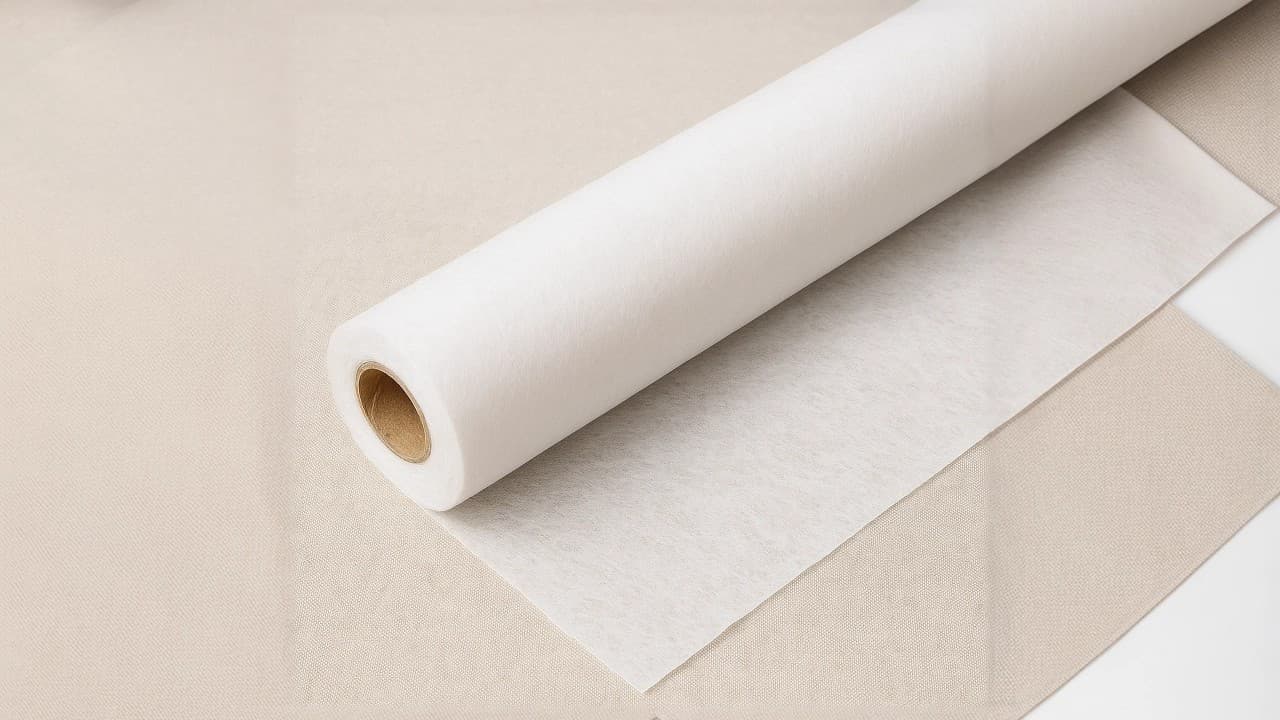
Interlining is a material that simplifies working with fabric and helps create neat and durable products. It is used both in clothing and in decor, making it an indispensable assistant for craftsmen and professionals.
Using non-woven fabric allows you to save time, improve the shape and structure of products, and achieve a neat and high-quality result without complex technologies or special equipment.
Non-woven fabric: what kind of material is it and why is it needed?
Interlining is a versatile nonwoven material that is used in a variety of areas. From the clothing industry to decor, it helps create a stable, durable base for many products. Despite its popularity, not everyone knows what its properties are.
In this review, we will cover everything: what is interlining fabric, what is it used for, how it is produced, and how to choose the right option for different purposes.
What is interlining fabric?
Definition and composition
Interlining is not created by weaving fabric, but by mechanical or chemical action on the fibers. The main components are cellulose and polyester. Sometimes synthetic fibers are added to increase strength.
History
Interlining appeared in the middle of the 20th century as a lining material for the clothing industry. It quickly became popular due to its ease of use and durability. With the development of technology, its properties improved and its scope of application expanded.
Properties of non-woven fabric
- Density. Light interlining is suitable for clothing, dense interlining is suitable for rigid parts (collars, cuffs).
- Rigidity. Depends on density: light is flexible, dense is rigid.
- Moisture resistance. Tolerates high humidity well.
- Breathability. Allows air to pass through without creating a thermal effect.
Advantages and Disadvantages
Pros:
- Versatility – for clothing, decor and handicrafts.
- Easy to use - can be glued or sewn on.
- Durability – maintains shape and quality.
Cons:
- Limited flexibility of dense non-woven fabric.
- Sensitivity to overheating (the adhesive layer may be damaged).
Types of non-woven fabric
By method of application
- Adhesive. Has an adhesive layer, activated by heat. Quickly fixed to the fabric, used for collars and cuffs.
- Non-adhesive. Attaches with seams. Suitable for delicate fabrics and situations where flexibility is needed.
By density and rigidity
- Lightweight. For thin fabrics, delicate parts.
- Medium. For linings and decorative elements.
- Dense. For collars, cuffs, shoulder pads.
Production of non-woven fabric
Raw materials:cellulose and polyester fibers.
Technology: fibers are glued together without weaving, a fabric is formed. For adhesive interlining, an adhesive layer is applied. Then impregnation increases moisture resistance and durability.
Using non-woven fabric
- Sewing industry. Strengthening of clothing parts: collars, cuffs, linings.
- Decor. Wallpaper on a non-woven base is practical and convenient.
- Handicraft. Embroidery on non-woven fabric retains clarity and neatness.
How to choose non-woven material?
- Purpose: for embroidery, sewing or decoration.
- Density: light, medium, dense.
- Thickness: for soft or hard fabrics.
- Adhesive layer: is it necessary for ease of gluing?
Some Alternatives
Analogues: dublerin – a dense fabric with an adhesive layer; spunbond – a non-woven material resistant to moisture, often used in packaging and construction.
Conclusion
Non-woven fabric has a wide range of applications – in the sewing industry, decor and handicrafts. Depending on the type and density, it can be used to create linings, decorative elements or wallpaper. Ease of use and a variety of types make it a universal material for any project.


